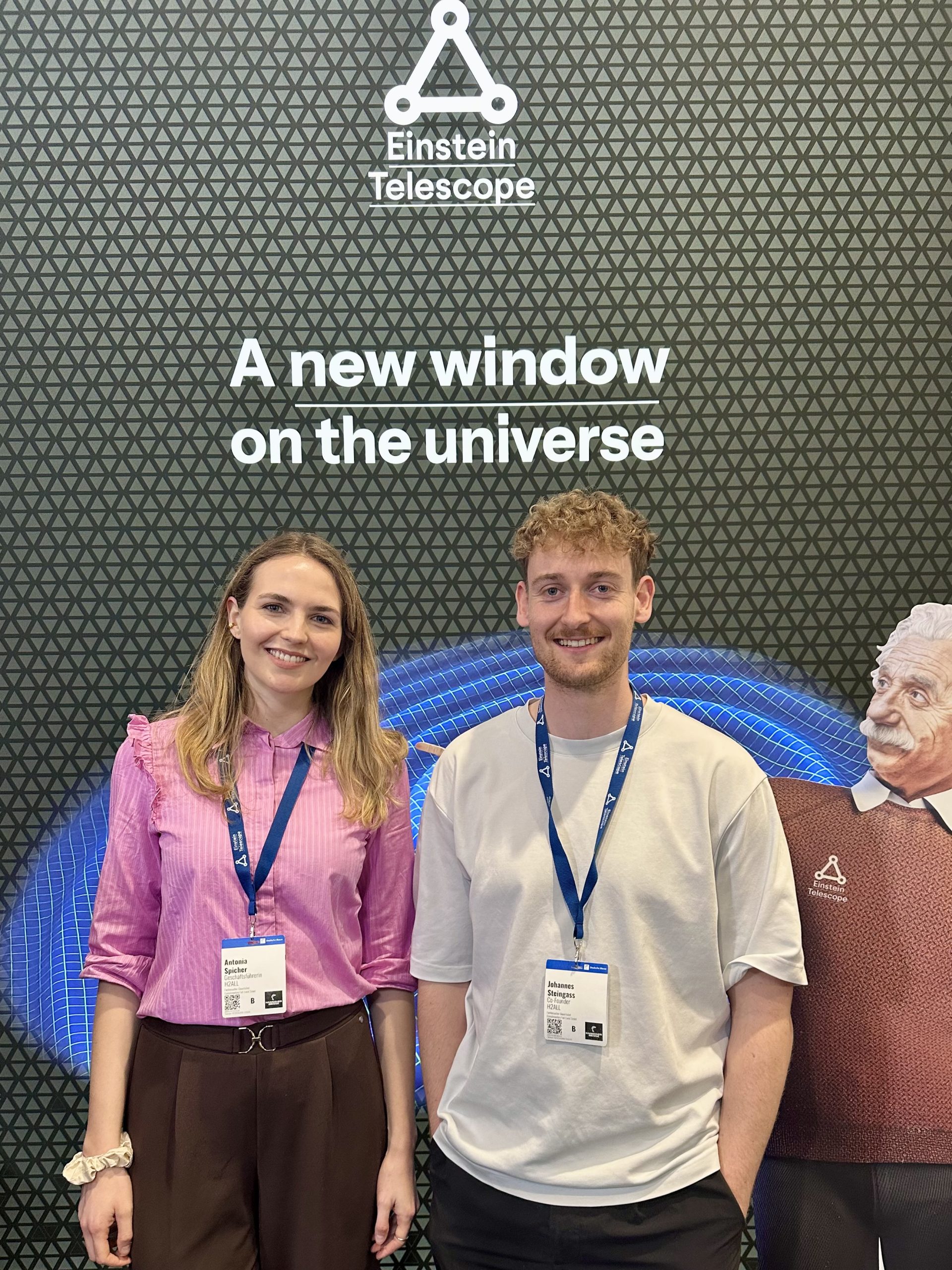
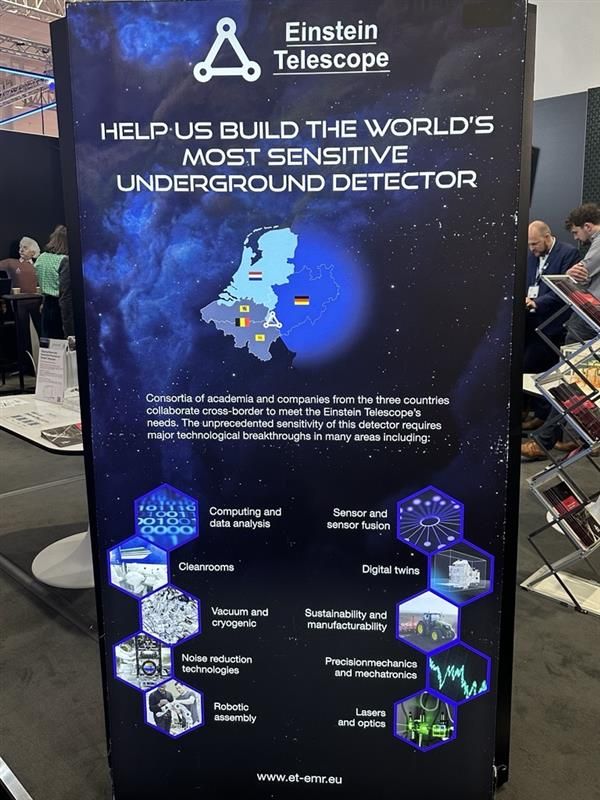
On the opening day, Dutch Minister Rianne Letschert visited our stand – together with ministers and ambassadors from Germany and Belgium. Former ESA astronaut Frank De Winne drew an impressive connection between space research and the underground gravitational-wave detector that the Einstein Telescope consortium is building across three countries.
Our contribution:
Detecting gravitational waves generates enormous amounts of data. That data needs a home – a data center that runs resiliently and sustainably. And what keeps a data center running when the power grid fails? Hydrogen. As a reliable backup system, H2ALL ensures that the detector’s data infrastructure stays online under all conditions.
What moved us most that day: scientists, engineers, policymakers and companies from three countries working together on a single mission. It is a powerful image – and a strong reminder that complex challenges can only be solved when research, politics and industry move forward together.
Milestone · April 2026
H2ALL at the Einstein Telescope consortium stand · Hannover Messe 2026
Antonia Spicher and Johannes Steingass represented H2ALL at one of Europe’s most important industrial trade fairs – in direct contact with ministries and embassies from Germany, the Netherlands and Belgium, as well as former ESA astronaut Frank De Winne.
#EinsteinTelescope
#HannoverMesse2026
#GravitationalWaves
#Hydrogen
#EMR
For H2ALL, this appearance means more than visibility: it shows that hydrogen as an energy carrier is in demand in a wide range of contexts – from the construction site to the data center of one of Europe’s largest science projects. We are proud to contribute.
Film tip: Spacetime – the era of gravitational waves
If you would like to dive deeper into the world of gravitational waves, we recommend the science film “Spacetime, the era of gravitational waves”. It was awarded best scientific film in Cannes.